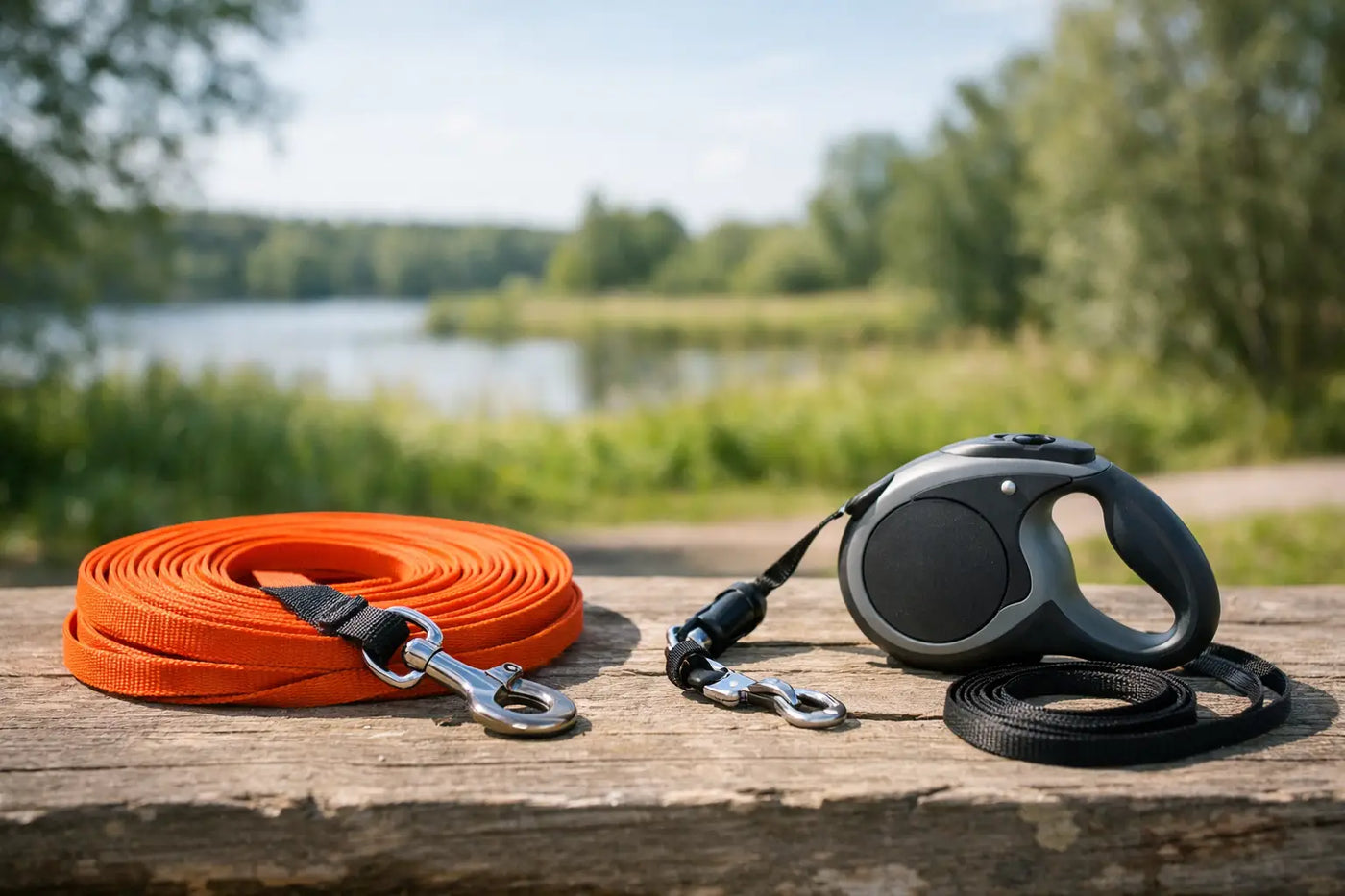
It is often noticeable after just a few walks. A dog wants to sniff the ditch, take the long way around the path, and feel a bit of freedom, while you want control, security, and a leash that actually works in everyday life. That is precisely why the question of a tracking leash versus a retractable leash is so common—and the answer is rarely black or white.
Both options can be good, but they suit different dogs, different environments, and different goals. What feels convenient on a quiet forest path can be completely impractical in the city. And what works well for recall training might be the wrong choice for a quick evening walk around the block.
Tracking leash or retractable leash - the big difference
The simplest difference is that a tracking leash is a long, fixed line without a built-in reel, whereas a retractable leash automatically rolls in and out from the handle. The tracking leash is often used for training, recall, and freer movement in nature. The retractable leash is used more often for everyday walks where you want to give the dog a bit more leeway without carrying around several meters of loose line.
It sounds simple, but the feel in use is very different. A tracking leash requires more active handling from you. You need to keep track of how the line is laying, avoid tangles, and adjust the length according to the space. A retractable leash feels more self-sufficient, but that doesn't automatically mean it is safer or better. The thin line, the locking mechanism, and the fixed handle impose their own requirements.
So the choice is less about which product is more popular and more about how you actually live together. Do you have a curious young dog practicing recall? Do you walk mostly in the woods? Or do you need something for densely populated environments, sidewalks, and quick potty breaks?
When a tracking leash is the better choice
The tracking leash really comes into its own when the dog needs freedom under controlled conditions. It is particularly appreciated for recall training, scent work, and walks in more open environments where you want to let the dog move naturally but still have a safety line.
The beauty of a tracking leash is that it provides clear contact. You can often feel directly what the dog is doing, how the pace changes, and when you need to gather in the line. For many dog owners, it also feels safer to work with a fixed line than with a mechanical solution. There are fewer parts that can malfunction, and you get more direct control over the length.
For dogs that easily get stressed by jerks or sudden resistance, the tracking leash can also be gentler to use, provided it is handled correctly. It often encourages a calmer interaction, especially during training where you want to reward the right behaviors without it becoming jerky.
At the same time, you shouldn't romanticize it. A long line dragging across the ground can get stuck in roots, and become muddy, wet, and heavy. If you have a strong dog or poor technique, it can quickly become quite messy. Gloves are sometimes a better idea than one might think.
Tracking leashes are often best suited for:
A tracking leash is often a wise choice if you are training recall, walk a lot in nature, or have a dog that needs more room to move than a regular leash allows. It also works well for puppies and young dogs who are not yet ready to be off-leash but need to practice freedom step by step.
When a retractable leash can work really well
The retractable leash has received both praise and criticism, and it is quite easy to understand why. Used the right way, it can be convenient, especially for calm dogs in environments where you want to be able to adjust the reach quickly without managing a loose line. For certain everyday walks, it feels simple and comfortable.
If the dog walks nicely, doesn't bolt, and you yourself are attentive, a retractable leash can provide a pleasant feeling of freedom. The dog gets the chance to sniff a bit further away, and you avoid gathering or carrying several meters of line. For many dog owners, convenience is the big plus.
But there are clear limitations. Retractable leashes are less suitable in environments with many people, traffic, bicycles, or other dogs nearby. There, you often need quick, precise control—not a few extra meters of line that must be locked in the right second. For dogs that pull, lunge, or suddenly dash, a retractable leash can also be both difficult and unsafe to handle.
So, it is not about retractable leashes always being wrong. It is about the fact that they require the right dog, the right place, and a handler who uses it with forethought.
Safety first - regardless of what you choose
It is easy to get caught up in what feels convenient for us humans, but the leash needs to function safely for both. With a tracking leash, the most common risk is that the line gets tangled around legs, bushes, or hands. With a retractable leash, the risks are more often about the thin line, sudden jerks, and the dog getting too far away before you have time to react.
An important rule of thumb is to always adjust the length according to the surroundings. In an open area, more reach can be lovely. By the road, in a parking lot, on a walking path, or when meeting other dogs, the leash needs to be shortened immediately. There, your attentiveness plays a bigger role than which model you have in your hand.
It is also wise to think about the dog's size and strength. A small dog with a gentle pace poses completely different requirements than a strong, fast dog that likes to make sharp turns. Equipment that feels perfect for one individual can be completely wrong for another.
Material and feel make a big difference
Tracking leashes come in several materials, and that affects more than many think. Some are light and flexible but absorb moisture. Others are more durable and easier to wipe off but can feel stiffer in the hand. Retractable leashes also differ in terms of handle, brake, and cord or tape. Small details make a big difference when you use the leash every day.
If you enjoy long walks in the woods and fields, it is worth choosing something that feels good even when it gets wet, cold, or dirty. Practical beats stylish pretty quickly when you are standing there with muddy shoes and a happy dog that wants to keep going.
What suits different types of dogs?
A confident, adult dog with stable walking behavior can work well with a retractable leash in the right environment. A puppy or young dog still learning to be compliant, however, often gets better support from a tracking leash during training. For dogs with a high prey drive, dogs with a lot of energy, or individuals that like to follow scents, a tracking leash is often the more controlled choice.
If you have a dog that easily gets stressed during encounters, it is also worth thinking twice. A retractable leash can give too much leeway in the wrong situations and make it harder to control the distance. A tracking leash isn't automatically the solution there either, but it can provide more active and clear handling if you use it consciously.
For small companion dogs that mostly walk in quiet areas, a retractable leash can feel sufficient for everyday life. For active dogs and outdoor life, however, a tracking leash usually wins on functionality.
Tracking leash or retractable leash in everyday life
In practice, many dog owners end up needing both, but for different things. The tracking leash comes along to the woods, the meadow, and for training. The retractable leash is perhaps used for certain quiet walks where the environment allows it. It doesn't have to be one or the other forever.
The most important thing is not to use a leash just because it happens to be the one closest to the door. Consider the day's route instead. Are you going to train, stroll, meet a lot of people, or give the dog time to sniff around? When the purpose is clear, the choice becomes easier.
For many families, it also works better when everyone uses the equipment in the same way. The dog thrives on clarity. If the leash implies different rules depending on who is holding it, the walks often become more chaotic than they need to be.
How to choose the right one for you
If you want a simple piece of advice for yourself, it is this: choose a tracking leash when the goal is freedom during training and nature walks, and choose a retractable leash only if the dog is stable, the environment is calm, and you really enjoy that type of handling. If you feel the least bit unsure, a tracking leash is often the more forgiving choice.
It doesn't have to be complicated. Think about where you walk, how your dog moves, and how much control you want in the moment. The best leash is not the one that sounds the smartest, but the one that makes the walk calmer, safer, and more fun for you both.
At Labbetass, we love products that truly make dog life easier, especially when they fit both everyday life and small adventures outdoors. Because when the leash works as it should, you get more time for what actually matters—the sniffing, the steps beside you, and that little moment when everything just flows.
Choose what helps your specific dog succeed, not what seems most practical on paper.