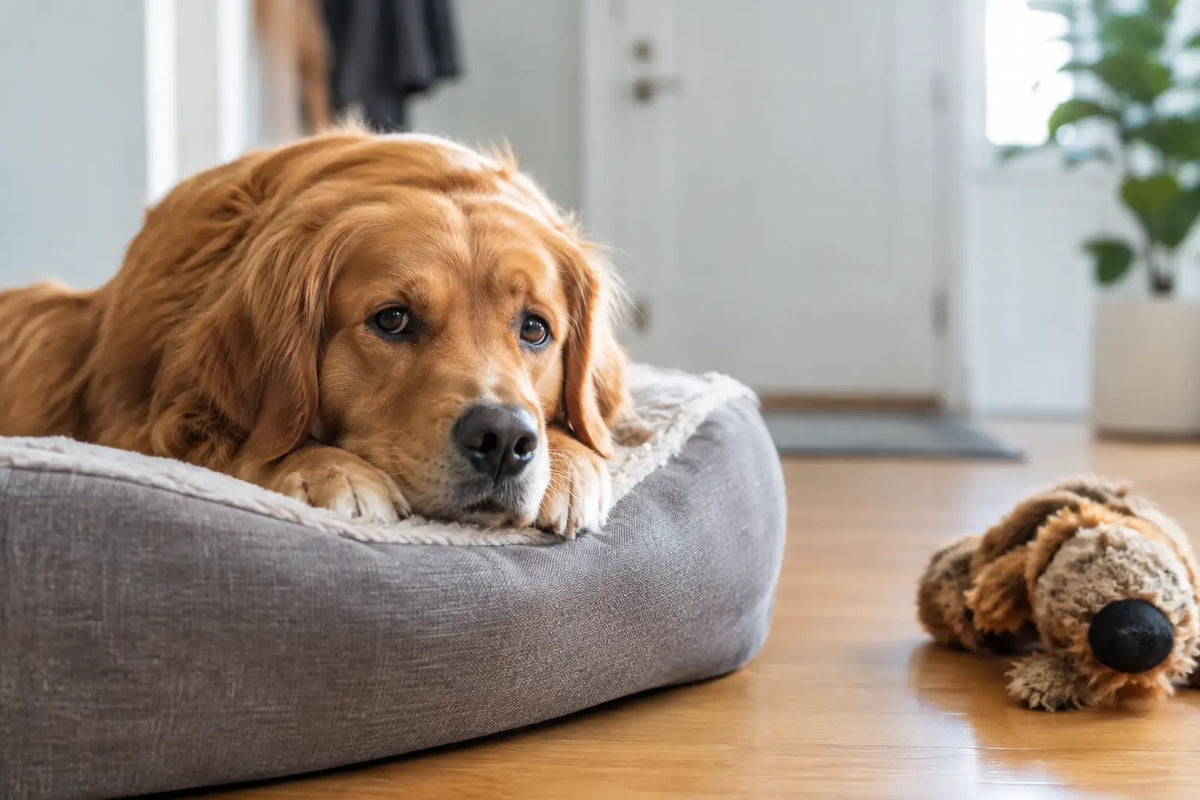
It is heartbreaking to close the door and hear your dog start barking, howling, or scratching as you head out. If you are looking for help with separation anxiety in dogs, you are far from alone. Many dogs find time on their own difficult, but with the right pace, more secure routines, and support when needed, everyday life can change for the better.
Separation anxiety is not about the dog being defiant or wanting to "punish" you for leaving. It feels real distress when an important person disappears. It must therefore be met with care and training that builds self-confidence, not with reprimands when you return home.
When being alone becomes too difficult
A dog with separation anxiety may begin to get anxious the moment you put on your shoes, pick up your keys, or walk toward the hallway. It might follow you from room to room, pant, shake, or refuse treats when it realizes you are about to leave.
Once the dog is alone, the distress may manifest as persistent barking, howling, drooling, restlessness, chewed door frames, or accidents indoors. Some dogs become completely silent and still, but are still stressed. A simple home camera can provide a fairer picture of what happens in the first few minutes after you have left.
It is good to distinguish separation anxiety from under-stimulation. A dog that becomes restless after several hours alone may need better balance in its daily life. A dog that panics within seconds or minutes of departure needs the actual time alone to be trained very carefully. Sometimes, both occur simultaneously.
Sudden changes in behavior should always be taken seriously. Pain, digestive issues, hearing loss, or other health problems can make a previously secure dog more sensitive. Book a veterinary assessment if the symptoms appear suddenly, are intense, or if your dog is hurting itself in its stress.
Separation anxiety in dogs - help in the right order
The most important thing is not to let the dog practice panic, if it can be avoided. Every time it becomes truly afraid while alone, the feeling that departures are dangerous is reinforced. During the training period, it may therefore be wise to coordinate with family, dog sitters, work, or run short errands so that absences are kept within the dog's current threshold.
This is not always practically possible, and it does not have to be perfect. The goal is to create as many safe repetitions as possible while you build up the time step by step. For some families, progress is rapid. For others, especially if the dog has been stressed for a long time, weeks or months of calm work are needed.
Start below the dog's stress threshold
The training should feel almost ridiculously simple at the beginning. Perhaps your dog can remain calm while you go into another room and close the door for two seconds. Maybe you start by just putting on your jacket, sitting back down on the sofa, and leaving the keys where they are.
Make one small change at a time and return before the dog has time to become anxious. If it stands up, stares at the door, stops chewing its treat, or starts panting, the step was too difficult. Go back to a shorter and simpler level next time. Progress is not about forcing minutes, but about creating many experiences where you leave and return without anything terrible happening.
Make departures less charged
For many dogs, everyday signals are more difficult than the door itself. Therefore, practice taking out your bag, walking to the hallway, or opening the front door without actually leaving the home. Repeat this in small, undramatic moments until the signals lose their meaning.
When you do leave, keep the departure friendly but low-key. A long, emotional ritual can make the moment bigger than it needs to be. The same applies when you return home: greet them warmly, but wait a few calm seconds until the dog has settled down before you start the day's big reunion.
Increase time unevenly and slowly
When short durations work, you can start to vary them. Two seconds, five seconds, three seconds, then eight. Always increasing in a straight line can make the dog tense and expectant. Small, simple repetitions between the longer ones help it maintain its calm.
Feel free to film the training. It is easy to miss subtle signs of distress when you are outside yourself. If the dog becomes stressed, it is not a failure, but information: the next session needs to be shorter, calmer, or less complex.
Build a daily routine that helps the dog wind down
A walk and a moment of activity before being left alone can make a big difference for many dogs, but it does not solve separation anxiety on its own. An overtired dog may even find it harder to relax. Focus instead on a moderate walk with time to sniff, a calm moment at home, and then a predictable departure.
The home can also become a safer place to be left in. A soft bed in a room where the dog usually rests, muffled sound from the radio or calm background music, and a comfortable temperature can help some dogs. For others, an open space and the freedom to choose where to lie are more important. Test carefully and follow your dog's reaction.
Occupation can be a nice complement if the dog is still able to eat when you leave. A safe chew, a filled enrichment toy, or a simple scent exercise can create a positive start to the time alone. If the dog ignores everything it normally loves, the stress level is likely too high, and then the training needs to back up rather than the toy being replaced.
Avoid shutting the dog in a crate or a small room as a quick fix, especially if it is already trying to escape. Some dogs rest best in a confined, familiar environment. Others panic more when their freedom of movement is restricted. Safety always comes before a standard solution.
Products that can support, without promising too much
The right things at home can make the training period a bit more pleasant, but no product replaces a plan for separation training. See them as support, not as the entire solution.
A comfortable bed can give the dog a clear resting place, especially if it is already associated with calm moments with you. Enrichment toys and durable chews can be suitable for dogs that can eat during short, safe periods of absence. A camera is often one of the most useful investments because it shows how the training is actually landing with the dog.
Some families also want to try pheromone diffusers, calming supplements, or calming garments. The results vary greatly between individuals. Talk to a veterinarian before using dietary supplements, especially if the dog is on medication, has illnesses, or if the anxiety is severe. Choose safe products and always introduce a new item when you are home yourself.
At Labbetass, good recommendations are about finding what fits your everyday life - from a resting place that invites peace to smart activation for calm moments at home. The finest choice is rarely the most advanced, but the one your dog actually enjoys and that you use consistently.
When you need extra support
Contact a veterinarian or a qualified canine behaviorist if the dog panics, destroys things in attempts to get out, injures itself, cannot be left alone even for a very short time, or if progress has stalled. Professional help can give you a clear plan and rule out medical causes. In some cases, the veterinarian can also discuss medications that temporarily lower the stress enough for the dog to be able to absorb the training.
Be careful with advice based on the dog "getting used to it" by being left alone until it stops making noise. Silence does not always mean calm. A dog can give up its attempts to communicate but still be afraid. Instead, choose methods that respect the dog's signals and make progress possible to maintain.
Your dog does not need to become perfectly independent overnight. It needs to experience, at its own pace, that the door can be closed and that you will always come back. Every calm minute you build together is a small step toward a freer and safer everyday life for both of you.