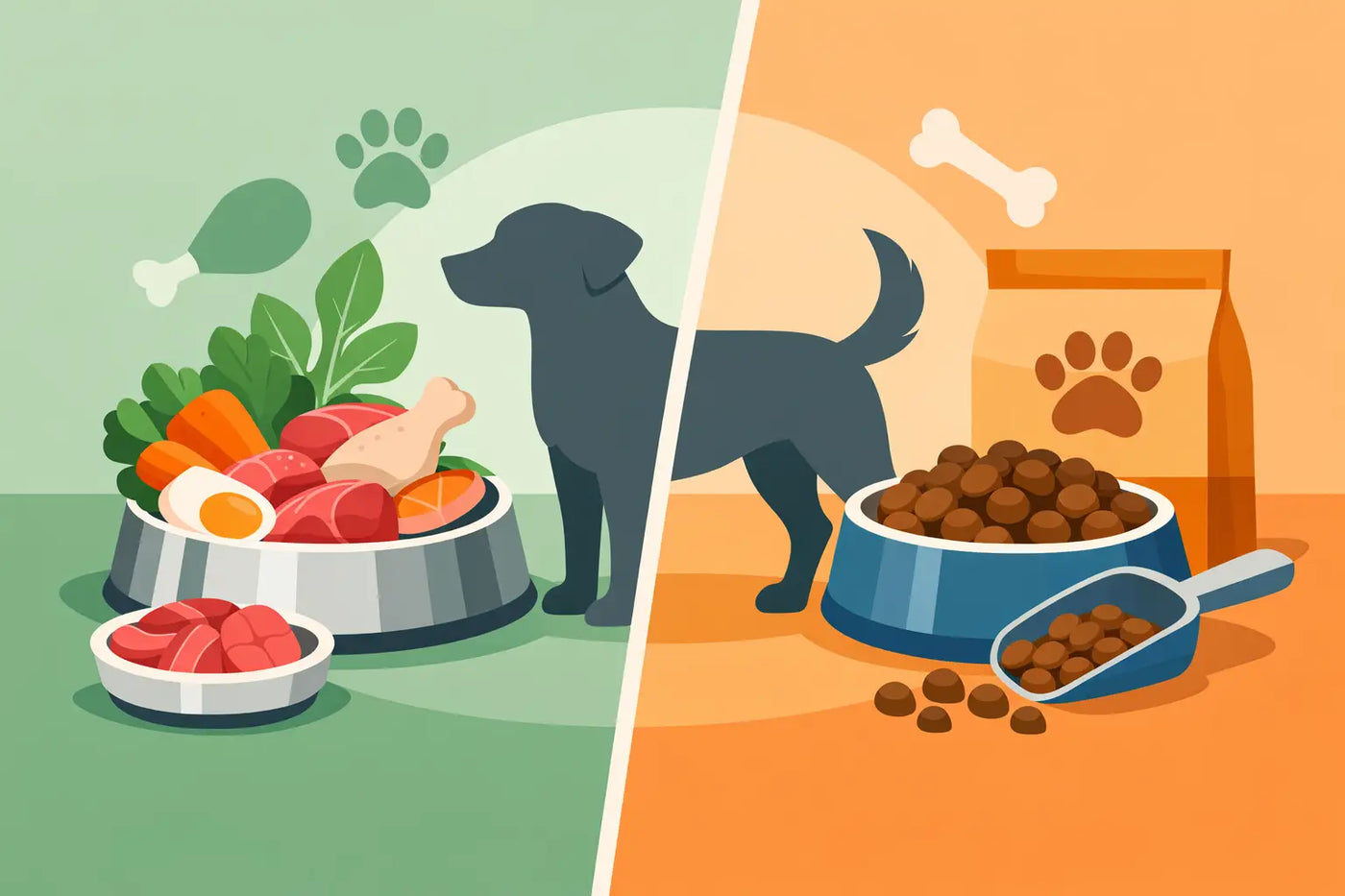
The food bowl quickly becomes a big issue when the dog is scratching more than usual, leaving half of its breakfast, or feeling a bit low on walks. Then the same question often arises: raw food versus kibble - what is actually best for the dog, and what works in an everyday life with work, weekend hangouts, and muddy forest hikes?
The short answer is that it depends on the dog, your daily routine, and how careful you can be with the quality of what you choose. Some dogs blossom on a raw food diet. Others feel great on a good kibble. And many dog owners end up somewhere in between, where the most important thing isn't the trend or the label, but how the dog is actually doing over time.
Raw food versus kibble - the real difference
The difference isn't just about raw versus dry. It's about how the food is composed, how it is stored, how simple it is to provide every day, and how confident you feel about the ingredients.
Raw food is often based on raw meat, organs, bones, and sometimes vegetables or other ingredients. Many dog owners like the feeling of providing something more natural and less processed. Kibble, or dry food, is cooked and dried to keep for a long time, to be easy to portion, and to function smoothly in everyday life.
This doesn't automatically mean that raw food is better and kibble is worse. A carelessly composed raw food diet can lead to nutritional imbalances. A well-thought-out kibble, on the other hand, can be complete, practical, and stable for many dogs. The quality within both categories varies quite a bit.
Nutrition is about balance, not just format
It is easy to get caught up in ingredient lists and fancy packaging, but the dog's body cares more about the whole. Protein, fat, vitamins, minerals, and the right energy levels matter more than whether the food comes in frozen blocks or crunchy kibbles.
Raw food is often praised for its high meat content and for being perceived as more species-appropriate. For some dogs, it can provide nice muscle tone, good appetite, and a healthy coat. But raw food also demands more of you as an owner. If the feed is not completely composed, or if you vary it in a way that becomes nutritionally uneven, it can affect the dog's health in the long term.
Kibble has the advantage that it is often designed to be complete straight out of the bag. This makes it easier to know what the dog is getting every day. For puppies, seniors, or dogs with special needs, it can be a reliable solution, especially if you want consistency without having to plan every meal in detail.
For dogs with sensitive stomachs
This is where raw food versus kibble becomes extra individual. Some dogs have a calmer stomach on raw food and produce less waste. Others react with loose stools, especially during quick changes or if the composition is too fatty. Kibble can be gentle and predictable, but some varieties with many ingredients or low quality can also create problems.
If your dog is sensitive, it is often smarter to think simple rather than extreme. Few ingredients, a slow transition, and keeping track of how the dog reacts week by week usually provide better answers than big, sudden changes.
Everyday life, hygiene, and what life actually looks like
This is the part that many forget. A food doesn't just have to look good on paper - it has to work on a Tuesday morning when you're already late, or at the cabin when the freezer is small and the dog is wet from the lake.
Raw food requires cooling or freezing, careful handling, and clean routines regarding bowls, hands, and surfaces. For some, it feels completely natural. For others, it becomes a source of stress that makes the entire feeding process more complicated than it needs to be.
Kibble almost always wins on convenience. It is easy to store, easy to bring along, easy to measure out, and simple if several people in the household are helping out. For families who travel a lot, hike, camp, or just want a flexible solution, it is a huge advantage.
That doesn't mean convenience should control everything. But if you choose a feeding system that doesn't fit your life, there is a risk that you will become inconsistent, and that is rarely good for the dog's stomach or routines.
Dental health, coat, and energy - what is noticeable at home?
Many who switch to raw food hope for cleaner teeth, better breath, a shinier coat, and stable energy. Sometimes that happens. Especially dogs that previously ate a food they didn't thrive on can show clear improvement when they get something that suits them better.
At the same time, it's easy to give all the credit to the food type itself when it is really about having switched from low quality to higher quality, or from incorrect nutrition to better balance. A dog that receives a really good kibble can also have a nice coat, lively energy, and feel excellent in their body.
When it comes to teeth, the picture is mixed. Some raw bones and chewing moments can help mechanically, but raw food itself is no guarantee for perfect oral health. Kibble doesn't automatically clean the teeth just because it's crunchy. Regular dental care still plays a role regardless of what is in the bowl.
The price tag is more than just the price per kilo
Raw food is often perceived as more expensive, and in many cases, it is. Especially if you choose high quality and need larger amounts for an active or large dog. There are sometimes also added costs for freezer space, more waste, and less flexibility.
Kibble is usually easier to budget for. You can buy larger bags, store them longer, and have a clearer idea of the cost per portion. But even here, the cheapest option is not always the most cost-effective. If the dog eats a lot, gets recurring stomach problems, or doesn't maintain its weight, a slightly more expensive but better food might be wiser in the long run.
For many dog owners, the best solution is the one they can actually afford to stick with. A stable, good feed that works month after month often beats a more ambitious plan that is hard to maintain.
Can you combine raw food and kibble?
Yes, sometimes you can, but it requires a bit of thought. Some provide raw food at home and kibble when traveling. Others use kibble as a base and supplement with raw meals or freeze-dried options. For some dogs, it works fine; for others, the stomach gets upset by the mix.
The most important thing is not to make too many changes at once. If you want to combine, start slowly and keep an eye on stools, appetite, energy, and skin. A dog that is doing well on a consistent routine doesn't always need a more advanced setup just because it sounds tempting.
How to tell if the food is a good fit
Regardless of whether you are leaning towards raw food or kibble, the dog's signals are the most useful. Look at the big picture. Are the stools consistent and normal? Is the dog at a healthy weight? Does the coat look healthy? Is there energy on walks without the dog becoming restless or sluggish? Does the appetite work without every meal becoming a negotiation?
These are small, everyday signs, but they often say more than big words about what is best.
Raw food versus kibble for different types of dogs
A young, active dog with a good stomach and an engaged owner can do great on raw food, especially if there is time, space, and interest to manage it properly. An older dog, a small dog with specific health needs, or a family dog in a hectic household can sometimes feel better on a well-thought-out kibble that is easy to keep consistent.
Puppies need extra careful nutritional balance, so here it is wise to be cautious with custom setups if you don't know exactly what you are doing. Dogs with diseases, allergies, or sensitive stomachs may also need more guidance than what social media and quick advice usually provide.
There are also dogs that are picky, dogs that wolf everything down, and dogs that seem to be able to eat anything until they suddenly can't anymore. Therefore, it is wise to view food as something living in everyday life, not as a choice of identity.
What often becomes the best choice
The best choice is often the one that meets three things at the same time: the dog's needs, your daily life, and a reliable quality. If you love the idea of raw food but know that you rarely have time to thaw, weigh, and handle it carefully, then maybe it isn't the right choice right now. If you use kibble but notice that the dog isn't truly thriving, then it might be worth looking at other options.
For those who want to shop smart, the same thinking applies as with leashes, beds, and everything else we choose for our dogs. Look past the marketing and think about what actually works at home with you. At Labbetass, that is exactly the type of choice we like - thoughtful, practical, and adapted to the life you actually live with a dog.
If you feel unsure, you don't need to win the perfect feeding debate. You need to find a meal that your dog thrives on, that you can give with a calm hand, and that allows both of you to put your energy where it belongs - out on the walk, on the sofa afterward, and in all those common, fine moments together.