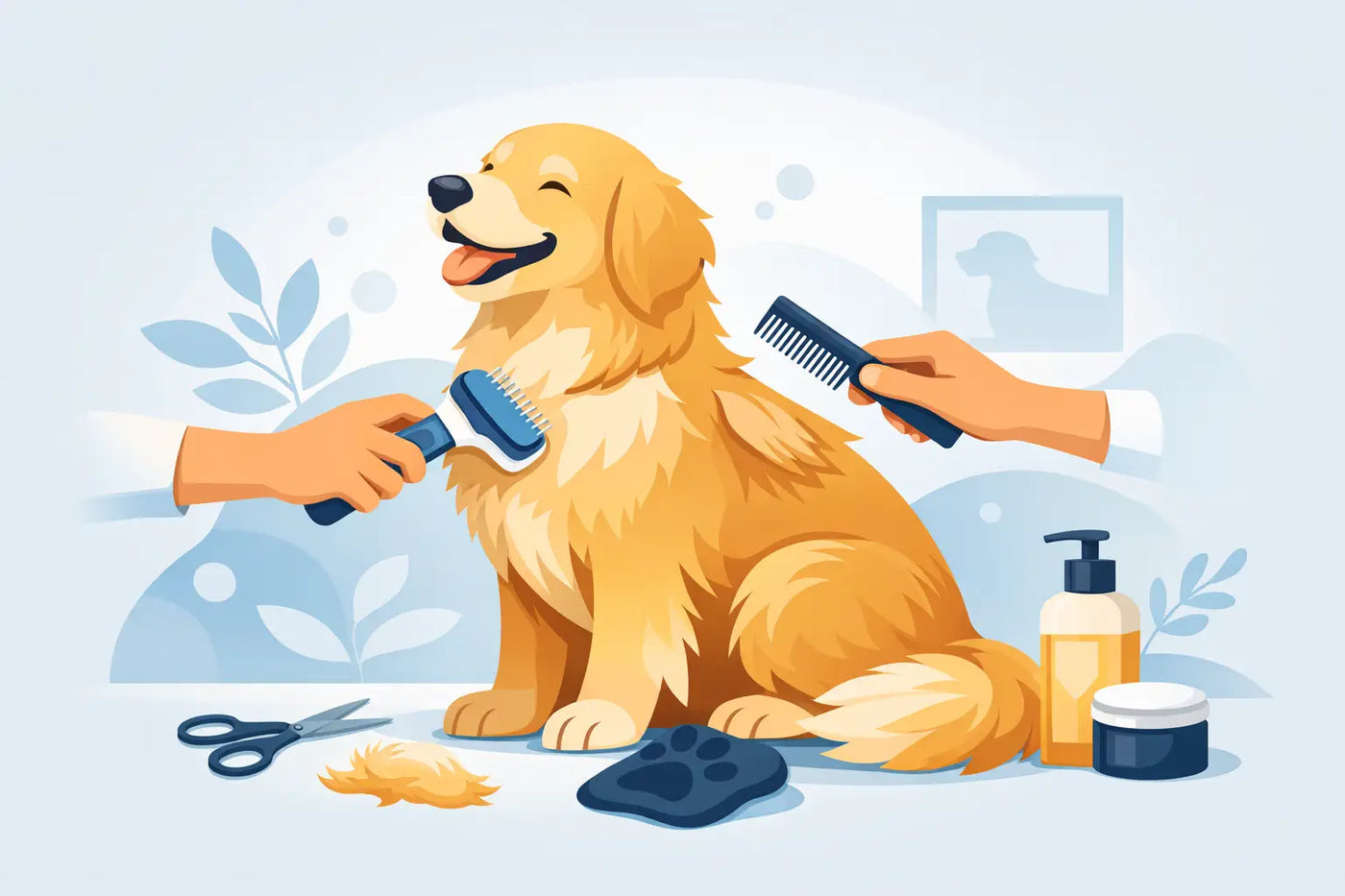
A wet walk, some forest trails, and a dog rolling around where it absolutely shouldn't—that's often when the real question arises: how do you take care of dog fur without making it more complicated than it needs to be? Good coat care isn't about the dog always looking freshly styled. It's about comfort, skin health, and making everyday life a little easier for both you and your four-legged friend.
The great thing is that good routines rarely need to be advanced. With the right brush, sufficiently frequent baths, and a little knowledge of your specific dog's coat type, you'll go a long way. And yes, it makes a big difference whether you live with a long-haired couch potato, a wiry little adventurer, or a short-haired dog that still manages to get fur all over the entire home.
How do you take care of dog fur in everyday life?
Most things are determined by three factors—coat type, activity level, and season. A dog that runs a lot in the woods and fields often needs more practical coat care than a dog that mainly goes on city walks. At the same time, a short coat might require less brushing but still more skin checks, since dirt, dandruff, or irritation are more visible.
Daily care almost always starts with brushing. Not because it looks nice, but because you remove loose hair, gravel, twigs, and small mats before they become a problem. In addition, you will notice more quickly if the skin is dry, if there is redness, or if something has gotten stuck in the coat.
For many dog owners, it works best to think "little and often." A few minutes after the walk, especially during wet or muddy periods, is often better than one long grooming project once a month. The dog gets used to it, and you avoid bigger tangles later.
Different coat types need different care
Not all dog coats work the same way, and this is where many people make it a bit more difficult for themselves than necessary. If you adapt your care to the coat, the result is usually both better and kinder to the dog.
Short-haired coats
Short-haired dogs are often perceived as easy to maintain, and that's partly true. The coat rarely mats, but it can still shed a lot and collect dust, pollen, and dirt close to the skin. A soft rubber brush or grooming glove usually works well to remove loose hair and stimulate the skin.
It is easy to over-bathe here. A short-haired dog that smells a little like a dog doesn't automatically need shampoo. Often, it's enough to wipe them down with a damp towel and let the coat air out.
Long-haired coats
Long hair requires more regular brushing, especially behind the ears, under the legs, on the chest, and around the tail where mats like to sneak in. If you wait until the coat feels tangled, brushing is often less pleasant for the dog.
The important thing here is to brush through the entire coat, not just the surface. Many long-haired dogs look well-groomed on top but have small mats close to the skin. A slicker brush or a comb adapted to the coat type helps, but technique also matters. Small sections and calm strokes are better than quickly dragging through the entire coat.
Double coats
Dogs with double coats, such as many spitzes, retrievers, and Nordic breeds, have both guard hairs and undercoat. They require extra care during shedding periods when the undercoat sheds in large quantities. Regular brushing then helps the dog get rid of loose fur and keeps the skin better ventilated.
Here, it's important not to be too harsh. The coat insulates against both cold and heat, so overly aggressive removal of the undercoat or incorrect trimming can interfere with the coat's natural function.
Wiry and curly coats
Wiry and curly coats often require more specific care. Some wire-haired dogs need to be stripped rather than clipped to maintain the correct coat quality. Curly dogs may shed less in the home but mat all the more easily if you are lazy with the brushing.
If you feel that the coat is changing, becoming dull, or starting to collect mats quickly, it may be a sign that your routine needs adjusting. It's not always more products that are needed—sometimes just the right rhythm.
Brushing that actually works
The best brushing is the one that actually happens. For some dogs, a few times a week is enough. For others, especially during shedding or with long hair, it's needed daily. The important thing is to make the moment calm and positive.
Feel free to start when the dog is relaxed, perhaps after the walk or in the evening. Brush in the direction of the coat and stop if you encounter resistance. If you pull on a mat, the dog quickly learns that grooming is something they would rather avoid. Instead, work carefully from the edge of the mat and inwards.
Rewards help more than many think. A few small treats, a calm voice, and short sessions make a big difference, especially if you have a young dog or an individual that doesn't love being handled.
When do you need to bathe your dog?
There is no perfect calendar for baths. A dog that swims in lakes, runs in mud, or has skin problems may need to be washed more often than a dog with dry skin and a calm daily life. However, too many baths with the wrong shampoo can dry out the skin and do more harm than good.
Always use dog shampoo when you do bathe them. Human products are rarely adapted for a dog's skin. Choose a mild shampoo and rinse extra carefully—residue in the coat can irritate more than you think. After the bath, it is important to get the coat completely dry, especially if the dog has a dense undercoat or long hair.
If the dog is only dirty on the paws and legs, it is often enough to just rinse those parts. A full bath doesn't have to be the default solution every time.
Coat care during shedding
Shedding periods can feel like a full-time job, especially in the spring and autumn. It's smart to help the coat along instead of trying to fight it when hair is already lying everywhere. More frequent brushing makes a big difference and reduces the amount of fur that ends up in the sofa, the car, and your workout jacket.
This is also where patience is needed. A dog that sheds a lot is not necessarily poorly cared for. Often, it is completely normal. However, if the shedding becomes unusually heavy, uneven, or combined with itching, redness, or bald patches, it might be time to talk to a veterinarian.
Don't forget the skin under the coat
When talking about how to take care of dog fur, it's easy to focus on shine and softness. But the skin is really the foundation of everything. A nice coat rarely starts with a spray bottle—it starts with skin that is doing well.
Keep an eye out for dandruff, sores, rashes, unusual odors, or if the dog is licking and scratching itself more than usual. Sometimes it's about dry winter air, sometimes about allergies, parasites, or a shampoo that doesn't fit. You cannot brush away a skin problem, so recurring issues need to be followed up.
Diet also plays a part. The quality of the coat is often affected by the whole picture—nutrition, stress, sleep, activity, and general health. That doesn't mean every change in shine is dramatic, but it's worth seeing the coat as part of the dog's well-being, not just as something cosmetic.
Small habits that make a big difference
It's often the simple things that keep the coat in good condition. Wipe the paws and legs after wet walks. Feel through the coat after trips in the woods. Remove small mats immediately. Do not leave damp fur compressed under a harness or coat longer than necessary.
If you want to make coat care a little smoother at home, it can be wise to collect a few favorites in one place—the right brush, a towel, a mild dog shampoo, and perhaps a comb for sensitive areas. That type of everyday solution is often what makes the routine actually stick. At Labbetass, that exact feeling is central—less searching, more reliable choices, and more time out with the dog.
When it's smart to get help
Sometimes home care goes a long way, but not always. If you have a dog with a coat that mats easily, requires trimming, or becomes very dense during certain periods, a professional dog groomer can be a really good complement. It doesn't mean you've failed. On the contrary, professional help can make everyday life easier and more comfortable for the dog.
Especially if the coat has already become matted close to the skin, it's often better to seek help than to try to untangle everything yourself. Too rough brushing can hurt and create resistance toward future grooming.
A healthy dog coat is rarely about perfection. It's about your dog being able to run, rest, play, and come along on your daily adventures without being bothered by mats, dirt, or itchy skin. When coat care is allowed to be simple, regular, and adapted to your specific dog, it becomes a natural part of life together—not a project you put off until the weekend.