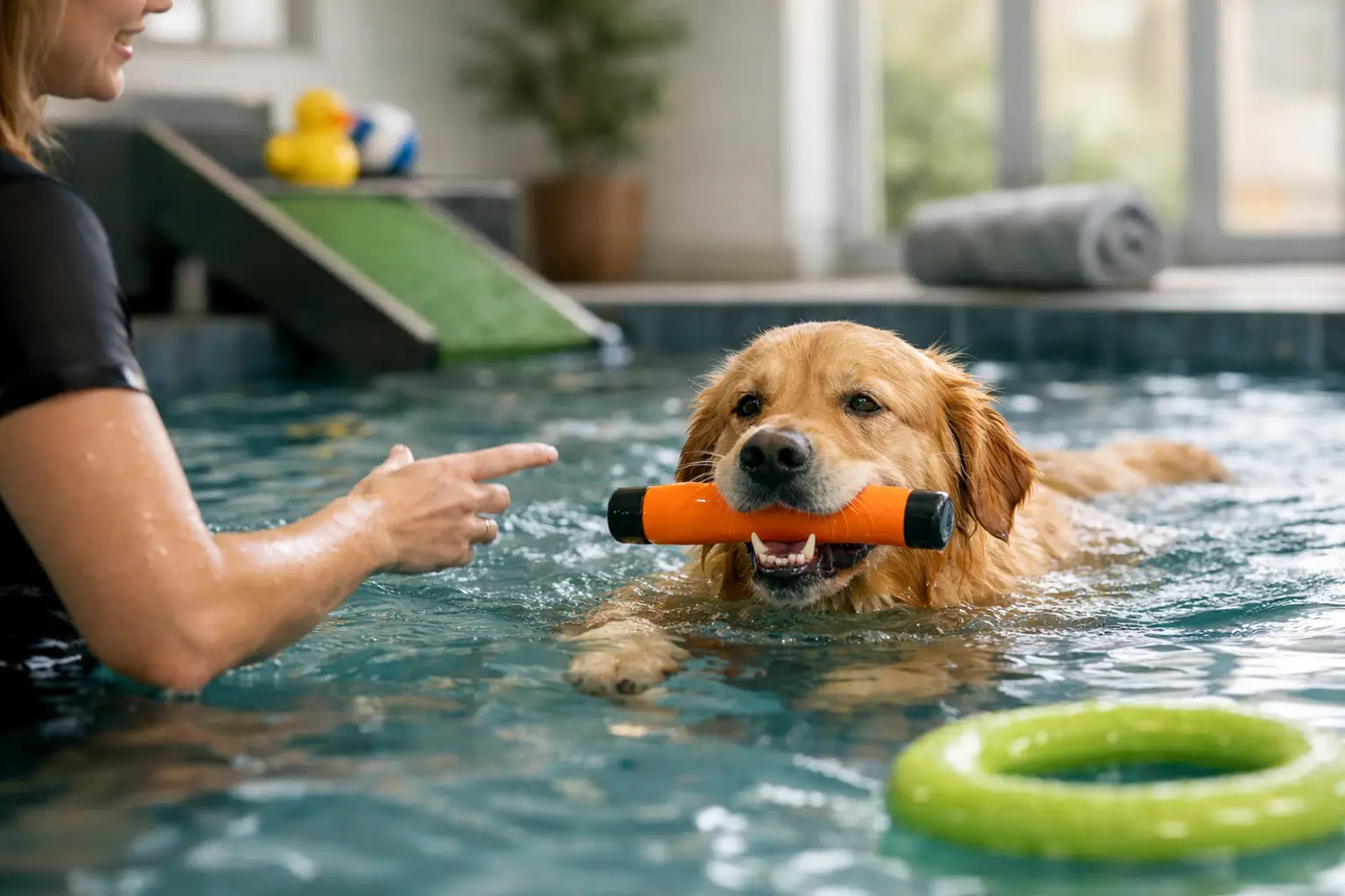
A dog that calmly paddles through water with its ears back and tail in a gentle wag has often found something truly delightful. Canine swimming training at home can be a nice complement to walks for water-confident dogs, but only when the environment is safe, the water is suitable for the dog, and the pace is entirely on the dog's terms.
It is easy to think that more water automatically means better exercise. That is not the case. For many dogs, the biggest reward is instead a positive moment together: a few safe minutes where the body can work gently and the dog feels supported, warm, and seen.
Canine swimming training at home starts with safety
By "at home" we do not mean that the dog should swim laps in the bathtub. A bathtub is too cramped for natural movements, slippery when the dog tries to turn around, and difficult to leave on its own. It is better suited for rinsing, paw care, and calm habituation than for swim training.
However, if you have your own pool, a safe swimming spot near your home, or access to a spacious dog pool, the conditions can be good. The dog should always be able to get in and out of the water without having to jump, climb, or be lifted in a panic. A sturdy ramp, shallow steps, or a gentle slope is more important than the size of the pool.
Never leave the dog alone in or near water, not even a dog that usually swims safely. Fatigue, cold water, a slippery edge, or an unexpected gulp of water can change the situation quickly. Stay close enough to provide support without interfering with the dog's own movements.
Start with water confidence, not distance
Some dogs happily throw themselves into the lake. Others first want to investigate the water's edge, sniff the ramp, and feel the water against their paws. Both reactions are completely normal. Never push a hesitant dog by pulling on the leash, throwing out a toy, or lifting it out where it cannot touch the bottom.
Instead, invite the dog with a calm voice and reward small steps forward. Perhaps you start by standing together in shallow water. Next time, the dog might take a few slow steps, turn back, and dry off. When it starts venturing out further on its own, you have built the kind of trust that makes future swimming sessions both more fun and safer.
If the dog freezes, tries to flee, pants unusually much, or avoids looking at the water, it is time to stop. Respecting a "no" is part of the training. Not all dogs need to love swimming to have a rich and active life.
How to make home swimming training gentle
The first sessions rarely need to be longer than two to five minutes in the water. That may sound like a little, but swimming uses the whole body and is significantly more demanding than a calm walk. It is better to take several short breaks where the dog can stand steadily, shake itself off, and catch its breath.
A well-fitting life jacket with a handle is a wise investment, even for dogs that are experienced swimmers. It helps the dog maintain a better swimming position, makes it easier for you to provide support if needed, and provides extra visibility in darker water. The handle is intended for short support, not for lifting a dog out of the water for longer periods.
Water temperature also plays a major role. Lukewarm to comfortable water is best for home training. Cold water can make muscles tense and drain energy quickly, especially for small, short-haired, elderly, or lean dogs. If the dog is shivering, becomes slow, or does not want to go back in, it is finished for the day.
Let the movements be gentle. You can walk parallel to the dog along a shallow edge, lure it to swim a very short distance toward you, or let it follow a toy near the water's surface. Avoid wild throwing, sudden turns, and repeated jumping from a dock or pool edge. This can strain the joints and back more than the gentle experience you are often aiming for.
Which dogs benefit from swimming?
Many healthy, adult dogs appreciate swimming as variety, especially on hot days or when regular walks need to be complemented with something kinder to the body. Active dogs can burn off energy, while older dogs sometimes appreciate the free feeling in water without hard ground beneath their paws.
But swimming does not suit everyone in the same way. Dogs with short noses may have difficulty keeping their airways clear and need extra caution, a life jacket, and very short sessions. Puppies are still growing and often have less endurance than one might think. Dogs with heart problems, respiratory issues, ongoing ear infections, fever, wounds, or pain should not be put into training on your own initiative.
If the dog has had surgery, is limping, or is recovering from an injury, the plan needs to come from a veterinarian or canine physiotherapist. Water training is often used in rehabilitation, but the correct water depth, movement, and dosage are individual. Home training can be a good complement only when you know what your particular dog needs.
Learn to read when the session is over
A happy dog does not have to be an indefatigable dog. Finish while the dog still feels energetic and positive, rather than when it starts to feel heavy in its swimming strokes. Signs that you should get out are that the hindquarters sink, the paws strike the surface stressfully, the dog looks for the edge repeatedly, or has difficulty focusing on you.
Afterwards, it is nice to rinse off chlorine, salt, algae, and dirt with clean water. Dry thoroughly, especially the outer parts of the ears, between the paw pads, and in skin folds. Do not let the dog run out into a draft or lie wet on a cold floor. An absorbent towel or bathrobe makes the transition from water to rest much cozier.
Then give the dog fresh water to drink and a quiet moment. Some want to curl up in their favorite bed immediately; others get a burst of happy energy and want to play. Both are normal, but still keep the rest of the day moderately active after a new or unusually long session.
Equipment that makes the moment easier
You do not need to fill your storage to get started. The most important things are a safe way out of the water and your undivided attention. But a few well-thought-out items make the experience more comfortable: a life jacket that sits close to the body without chafing, a long towel or bathrobe, fresh drinking water, and a simple toy that floats.
Choose equipment based on the dog's body, coat, and habits rather than color or trends. A dog with a deep chest needs a different fit than a small dog with a short back. Always test the life jacket on land first. The dog should be able to walk, sit, and turn around without the straps sliding or pressing behind the front legs.
For those who like to make dog life a little easier, this is a great category to plan for ahead of summer. The right everyday gear creates more time for what actually counts: wet paw prints on the dock, a towel over the shoulder, and a satisfied dog that gets to come along.
The best swimming session is not the longest one. It is the one where the dog voluntarily looks toward the water the next time you come there, confident that you listen when it wants to go in - and just as confident that you will help it out when it is finished.