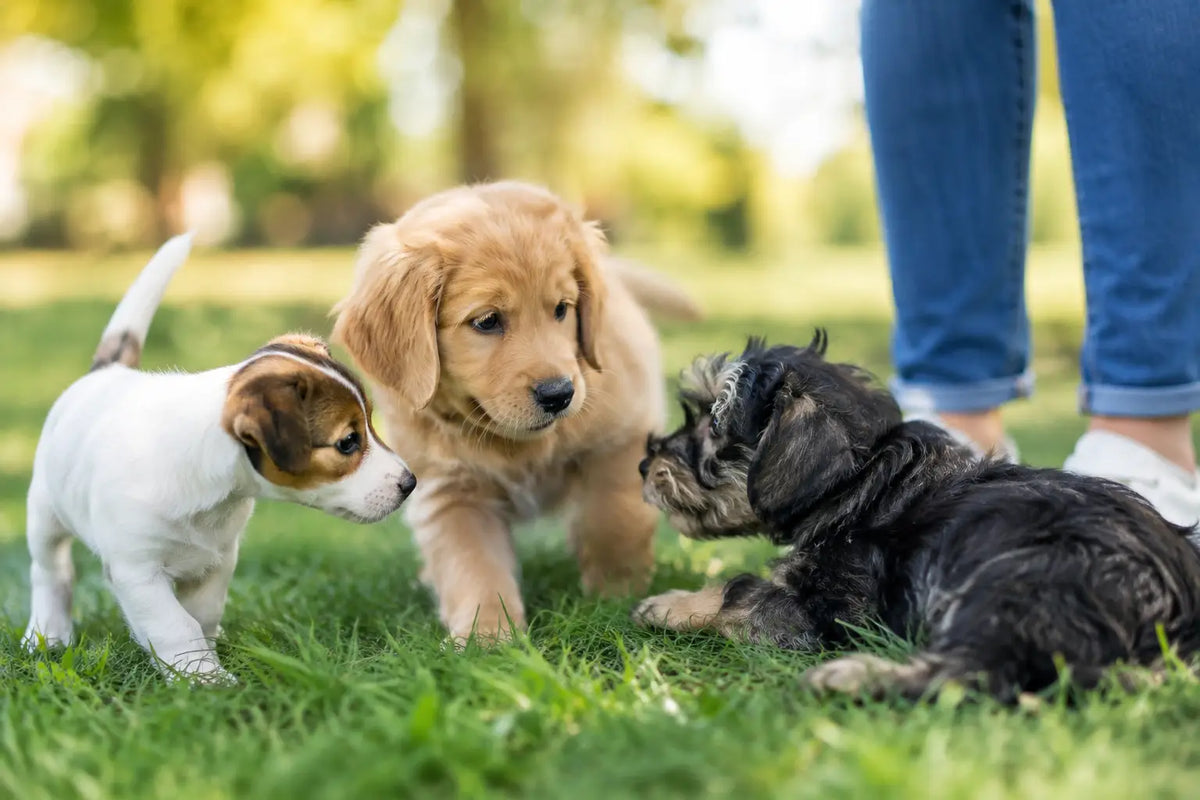
That first walk when your puppy stops in the middle of the sidewalk and stares at a trash can as if it were a spaceship? That isn't disobedience. It's a small dog trying to understand a big world. Therefore, a good guide to puppy socialization is less about managing to meet everything and everyone, and more about giving the puppy calm, positive experiences that feel just the right size.
Socialization lays the foundation for how the dog will encounter everyday life later on: people at the crosswalk, strollers in the park, jingling leashes, new homes, and forest paths that smell of game. But a confident puppy isn't created by being thrown into the center of the action. Confidence grows when the puppy is allowed to explore, choose its distance, and feel that you are there.
When does a puppy's socialization begin?
Puppies are often extra receptive to new impressions during their first few months. Many speak of a socialization period that is particularly sensitive up to about 12-16 weeks of age, but development certainly doesn't end there. Your dog learns its whole life. The difference is that early experiences often set the tone for what feels normal, fun, or worrying later on.
This doesn't mean the calendar should be filled with activities from morning till night. Puppies also need to sleep a lot, process impressions, and just be at home. A day with a short meeting with a calm neighbor and five minutes at a bench outside the grocery store can be more valuable than a long excursion with ten new dogs.
Think quality over quantity. The goal is not for your puppy to greet everyone, but for it to be able to see the world and feel secure in it.
Guide to puppy socialization - start small
Begin with environments where the puppy has plenty of space and where you can easily walk away if something becomes too much. A quiet street, a calm part of the park, or a friend's garden is often better than a bustling dog cafe or a crowded square.
Let the puppy stop, sniff, and watch. Standing a few meters from a bike path and observing bikes passing by can be socialization in its finest form. You don't need to lure the dog toward the bikes. Instead, reward calm behavior with a small treat, a soft voice, or the opportunity to continue sniffing.
This also applies to strange objects: umbrellas, rolling suitcases, reflective vests, garbage trucks, and playing children. If the puppy becomes unsure, increase the distance. Distance is not a failure - it is a tool that allows the dog to feel safe enough to learn.
People and dog meetings without pressure
A social dog is not necessarily a dog that wants to be petted by strangers. Many adult dogs are at their best when they can pass people and other dogs without needing to greet them. Therefore, give the puppy the experience early on that an encounter can be completely undramatic.
Ask visitors to let the puppy take the first step. They can squat down, turn to the side, and avoid reaching their hands over the puppy's head. If the puppy approaches, let the meeting be short and friendly. If it backs away, respect that immediately. That builds trust both in people and in you.
The same principle works with other dogs. Choose a stable, friendly adult dog rather than a group of excited playmates. Feel free to walk in parallel for a while with distance between the dogs before they are allowed to greet. That way, the puppy can read body language and get used to the presence without having to handle a quick nose-to-nose situation immediately.
Play is wonderful, but it should be reciprocal. Intervene gently if one dog becomes too intense, if the puppy tries to get away, or if the play becomes too rough. A short, nice play session that ends while both are still happy is better than waiting until someone gets tired or overwhelmed.
Environmental training for the life you want to live
Think about what your everyday life actually looks like. Do you live in the city with elevators, buses, and many sounds? Then short, calm sessions in that environment can be valuable. Do you spend your weekends in the countryside? Let the puppy explore soft forest paths, hear birds, and get used to rain on its jacket.
For a family that loves excursions, socialization can also be about resting on a blanket, taking short car trips, and waiting calmly while the thermos coffee is poured. A dog that has learned to relax next to you often finds it easier to join in life, whether the goal is a city weekend, a cottage trip, or a slow Sunday in the park.
Practice everyday handling situations in small doses at home. Look in the ears, touch the paws, brush a couple of strokes, and get the puppy used to putting on and taking off a harness. Always link the exercise to something pleasant and finish before the puppy gets tired. This makes grooming, nail clipping, and vet visits less dramatic over time.
A simple daily routine can include four different types of experiences:
- a calm environment to observe from a distance
- a short, positive contact with a person or dog
- a small handling exercise at home
- proper rest afterward
Learn to read when it's too much
A puppy that is happy and curious often has a relaxed body, can sniff, take treats, and turn back to you. A puppy that needs a break might freeze, yawn repeatedly, lick its lips, pull on the leash, or suddenly become very jumpy and bitey. Some become quiet, others sound more than usual.
View the signals as information, not as something that must be trained away on the spot. Walk a few steps away, sit in a quiet place, or end the activity. When you help the puppy before the stress becomes too great, it learns that new situations are manageable.
Also be aware of the common trap of thinking the puppy "gets used to it" just because it stops reacting. A dog that stands completely still and does not make contact might be overwhelmed rather than confident. Curiosity, relaxation, and the ability to choose are better measures of a successful experience.
Rewards that create the right feeling
Keep small, soft treats in your pocket when you go out. The reward doesn't just come from food. Being allowed to go and sniff a bush, coming back to the car, or getting some distance from something scary can also be a reward.
Praise calmly. You don't have to make every step forward a big celebration. Sometimes it's enough to say "good" in a warm voice, give a treat, and let the puppy continue at its own pace. That helps the dog understand that the world is safe without raising the stress level further.
Practical things can also make a big difference. A comfortable harness, a leash of the right length, water for the excursion, and a blanket that smells like home create better conditions for calm moments outside. At Labbetass, the idea is always the same: small, well-thought-out choices can make everyday life more pleasant for both human and dog.
When the puppy is cautious or very brave
Cautious puppies don't need to be "toughened up." They need to succeed in small steps. If your puppy looks at a stranger from five meters away and then eats a treat, that is progress. Next time, the distance might be four meters - but only if the puppy itself feels comfortable.
The overly brave puppy often needs to practice the opposite: stopping, waiting, and observing. Don't let every encounter be a greeting. Reward when the puppy can look at another dog and then turn its gaze toward you. That skill is worth its weight in gold when the dog gets bigger and stronger.
If the fear is strong, if the puppy often panics, or if you feel unsure, seek help early from a reward-based dog trainer or veterinarian. Early support can make everyday life easier for the whole family.
Let your socialization be a series of small moments, not a project to be checked off. Sit for a while on a bench, bring a blanket to the edge of the woods, and let the puppy discover the world with you as a safe anchor. That is how many of the best adventures begin.