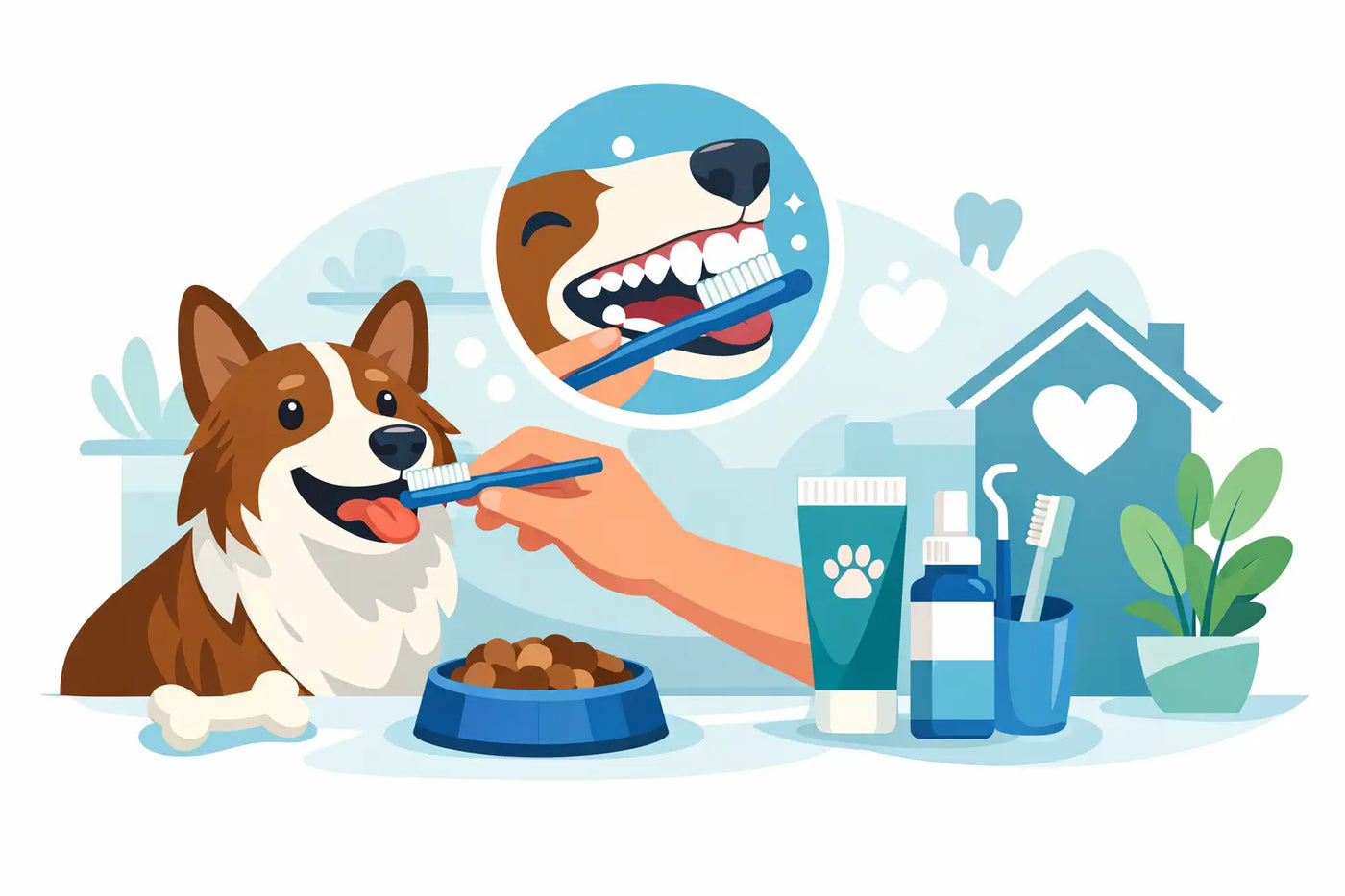
A dog that loves to run in the woods, sniff everything, and then curl up close on the sofa needs more than a nice harness and good food. The mouth plays a bigger role than many realize. This guide to dog dental care is for those who want to keep everyday life simple, while still making a big difference for your dog's health, breath, and well-being.
Why dental care for dogs is so easy to put off
It is rarely the teeth that get the most attention in a dog's daily life. We notice the coat, the claws, the stomach, and the energy immediately. Teeth often become one of those things you think you will deal with later, especially if the dog is still eating, playing, and seems happy.
The problem is that dental issues often creep up. Plaque becomes tartar, gums become irritated, and eventually, the dog can be in pain without showing it clearly. Many dogs continue to eat almost as usual despite discomfort. This means small signals are easily missed.
That is why dental care is not just a matter of fresher breath. It is about preventing inflammation, pain, and in some cases, major health problems later on.
Guide to dog dental care - what you actually need to do
The great thing is that good dental care doesn't have to be complicated. For most dog owners, a calm routine at home, the right tools, and a little patience go a long way. The most important thing is not that everything is perfect from day one, but that it is done regularly.
The most effective habit is tooth brushing. Not occasionally, but rather several times a week and preferably daily. It is still the best way to remove plaque before it has time to become tartar. Chews, supplements, and oral care products can definitely help, but they do not replace the brush entirely.
If your dog has never had their teeth brushed before, you don't need to start with a full routine right away. It often works better to think in small steps. First, let the dog get used to you touching their lips and looking in their mouth. Then you can introduce dog toothpaste on your finger, and subsequently the toothbrush itself.
How to start without making it a struggle
Choose a calm moment, preferably after a walk when the dog has already wound down. Sit close, speak softly, and keep it short. The first time, the goal can be as simple as lifting the lip for a few seconds and rewarding immediately.
When the dog feels secure, you can put a little dog toothpaste on your finger and let them taste it. Many dog toothpastes are made to be tasty. That helps. Then you can gently rub along the outside of the teeth, especially the back molars where plaque often gathers.
When that works, a soft dog toothbrush or a finger brush is the next step. Brush with small movements along the gum line. You don't need to try to open the mouth wide or reach every surface in the beginning. The outside of the teeth is the most important to get clean.
What to use - and what to skip
Not everything sold for oral health is equally helpful, and not everything suits every dog. There are also some common misunderstandings that can cause trouble.
Always use toothpaste adapted for dogs. Human toothpaste should not be used, as the dog does not spit it out and some ingredients can be inappropriate. A soft brush is usually the gentlest, especially if the gums are already a bit sensitive.
Chew sticks and dental chews can be a good supplement, especially for dogs that like to chew. But the effect varies. Some help mechanically by scraping against the teeth, others mostly provide a moment of occupation. Here, you have to be a little honest about what actually works for your own dog.
Some dogs love hard chews like bones, horns, or very compact products. They can last a long time, but they are not always the kindest choice for the teeth. If it is too hard, there is a risk that a tooth will crack. A simple rule of thumb is that if you think the product feels rock-hard, it is worth a second thought.
Mouth spray, powder, and supplements - are they worth it?
It depends on the dog and your routine. For a dog that already gets regular tooth brushing, such products can be an extra boost. For a dog where the brush is never used, they rarely become the complete solution.
Water additives, algae-based powders, and mouth sprays can be convenient for those who want to do something simple in everyday life. At the same time, the result is often more gradual and less clear than with brushing. If you see them as help along the way instead of a shortcut, expectations become more realistic.
Signs that your dog's teeth need more attention
A little "dog breath" is one thing. Bad odor that gets stronger over time is another. If the mouth smells really bad, there is often a cause worth checking out.
Common signals are yellow-brown coatings on the teeth, red gums, the dog chewing more carefully than usual, or avoiding harder pieces. Some dogs also start drooling more, pawing at their mouth, or turning their head away when you try to look at their teeth.
Some become unusually quiet, others irritated. This is exactly why dental problems are easy to misinterpret. You might think the dog is tired, picky, or just having a bad day, when it is actually about discomfort in the mouth.
When you need to book an appointment with a vet
Home care goes a long way, but not all the way in every situation. If the dog has clear tartar, inflamed gums, loose teeth, or seems to be in pain, a veterinarian needs to take a look. Sometimes professional dental cleaning is required, and sometimes there are injuries or infections that cannot be solved at home.
It is also wise to ask for an assessment during the regular health check, especially if you have a small dog breed or an older dog. Small dogs often get dental problems earlier and more frequently than many larger breeds. In those cases, it is rarely enough to just hope that chew products will do the job.
If the dog suddenly stops wanting to eat, whimpers while chewing, or gets swelling around the mouth, do not wait. In that case, it is better to check once too often than once too seldom.
How to make dental care work in real life
The best routines are almost always the simple ones. If you aim for a long, perfect evening ritual, there is a risk that it will never happen. If you instead link the tooth brushing to something that is already happening, like the evening walk or the last potty break, it becomes much easier to maintain.
For many, it works well to have the toothbrush visible, near the dog's other belongings. Then it becomes part of everyday life instead of a project. Two minutes a few times a week beats an ambitious plan that is put off month after month.
It also helps to think about personality. Some dogs accept dental care quickly if they get praise and a calm moment. Others need more training, more breaks, and shorter sessions. That is not a failure. It just means the approach needs to suit the individual.
Puppies, adult dogs, and seniors - different needs
Puppies need above all to get used to being handled. It is the best gift you can give yourself for the future. Make the mouth something undramatic early on, and dental care will be much easier later.
Adult dogs can often get into a routine quite quickly, even if they are not used to it. Here, consistency is more important than speed. A little bit often works better than a lot very rarely.
Senior dogs may need extra gentleness. If the gums have become sensitive or there is already wear and tear, you need to adjust the pressure and sometimes let the vet decide what is best. Older dogs can also hide pain very well.
An everyday routine that lasts over time
If you want to keep it simple, you can think like this: look in the dog's mouth regularly, brush the teeth as often as you realistically can, use products that feel safe and reasonable, and react early when something changes. It doesn't have to be more complicated than that.
Many dog owners spend a lot of time finding the right food, the right bed, and the right equipment for adventures outdoors. Dental care deserves the same attention, because it affects how the dog feels every day. A healthy mouth makes a difference far beyond the breath.
At Labbetass, we like things that make life with a dog a little simpler and a little better. Dental care is a perfect example. Small habits at home can yield big effects over time, and that is often where the finest gestures of care are found - in the everyday, calm, and regular.
Start where you are today, not where you think you should be. A quiet minute with the toothbrush tonight is worth more than yet another postponed plan to deal with it later.