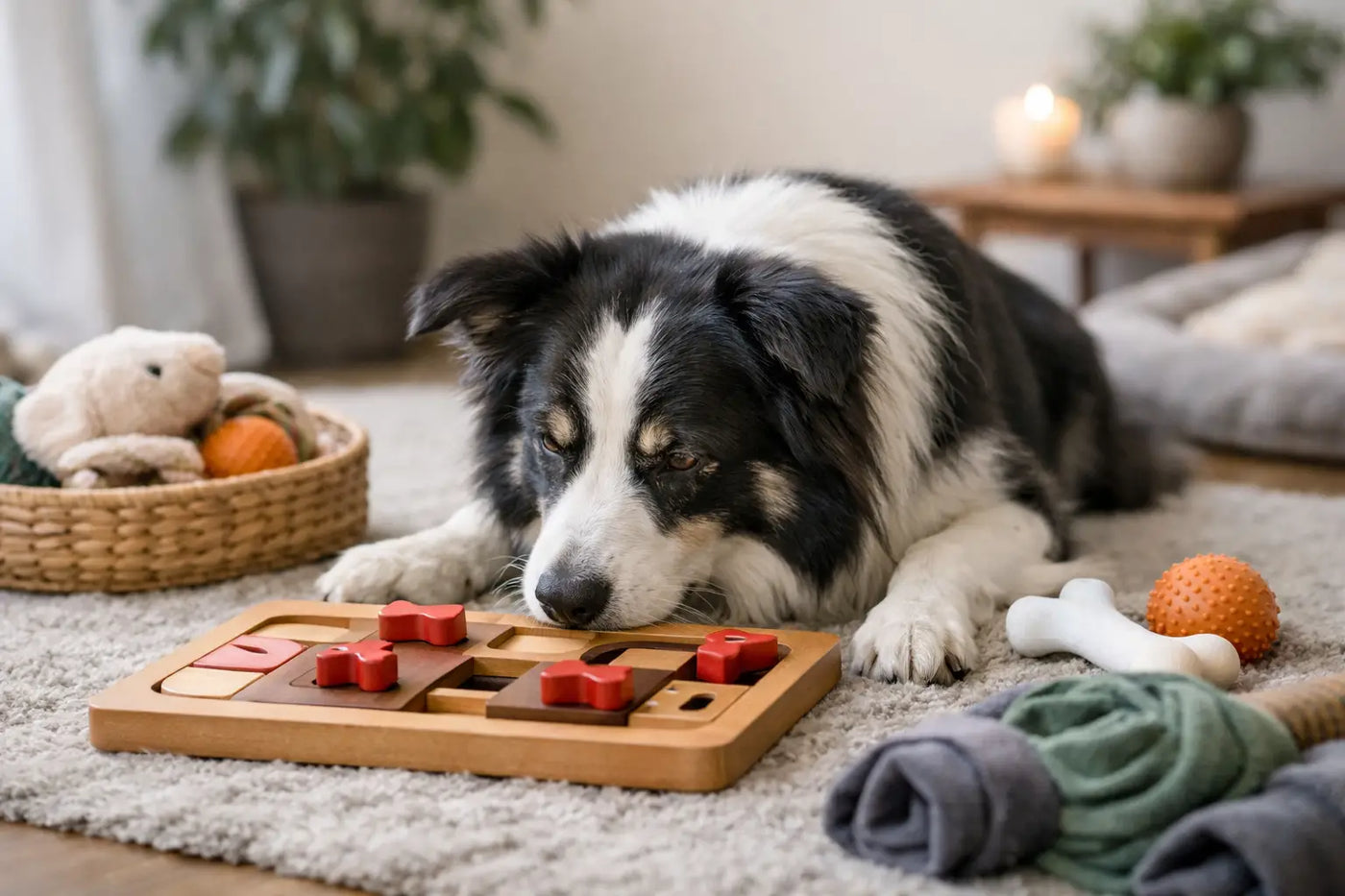
Some days the dog does not need more speed - it needs more focus. If the walk is already done but the body still feels restless, it is often the brain that wants something to work on. That is why examples of calm dog enrichment are so valuable, especially for rainy afternoons, recovery days, or for dogs that easily get overstimulated.
Calm enrichment is not about doing less for your dog. It is about choosing the right type of stimulation. Many dogs thrive on tasks where they get to sniff, think, search, and solve small problems at their own pace. The result is often a dog that feels satisfied, softer in its body, and more harmonious at home.
Why calm enrichment often works so well
It is easy to think that a tired dog is always a dog that has run a lot. But physical exercise and mental balance are not the same thing. A dog can be physically tired and yet mentally wound up. This is often noticed by the dog wandering around at home, having difficulty settling down, or starting to invent its own projects.
When you choose calm dog enrichment, you give the dog a chance to use its natural behaviors without the stress level spiking. Nose work is a clear example. Searching for scents, treats, or hidden objects requires concentration, and for many dogs, it feels both safe and satisfying.
This does not mean that calm enrichment is suitable for absolutely every situation. A young, energetic dog may still need proper exercise first. But as a supplement, it is often one of the most underrated parts of everyday life.
Examples of calm dog enrichment that actually make a difference
The great thing is that you do not need to make it complicated. Often, a few minutes, a little patience, and things you already have at home are enough.
1. Treat search in a towel or blanket
Roll a few small treats into a towel, blanket, or rug and let the dog sniff its way to them. This is simple, quiet, and especially suitable for dogs that like to work with their nose but do not need a difficult setup.
Start easy. If everything becomes too hard right away, the dog may become frustrated instead of calm. The idea is that it should succeed and get into a nice state of focus.
2. Spreading dry food on the lawn
If you have a small patch of grass, a garden, or a quiet part of a park, you can spread the day's kibble over a small area. This allows the dog to search calmly with its nose and take it piece by piece. It looks almost too simple, but it is often very effective.
For dogs that eat quickly from a bowl, this can also make mealtime more harmonious. At the same time, you get a moment that feels more like everyday enrichment than training.
3. Lick mat or filled enrichment toy
Licking is calming for many dogs. A lick mat with wet food, mashed banana, dog-friendly pâté, or soaked kibble can provide a really nice moment of concentration. The same applies to an enrichment toy that the dog has to work with methodically.
Here it is good to think about the content. Choose something the stomach can handle and keep the portion reasonable. For some dogs, an overly difficult toy becomes more irritating than fun, so it is wise to adjust the level.
4. Simple indoor search exercises
Ask the dog to wait in another room while you hide a few treats at an easy level. Then let it go in and search. You can start with visible hides and make it more difficult only after the dog has understood the game.
This is one of the best examples of calm dog enrichment when the weather doesn't invite any major outdoor adventures. It requires almost no space, but can still provide plenty of mental stimulation.
5. Slow problem solving with a cardboard box
An empty cardboard box, a few crumpled pieces of paper, and a couple of treats can go a long way. Let the dog sniff, nudge, and figure out how to get to the contents. For many dogs, this type of simple problem-solving is both fun and regulating.
Here you obviously need to think about safety. If your dog likes to swallow cardboard or rips everything up at high speed, it is not as suitable. In that case, nose work is often a better choice.
6. Training calm tricks
Calm enrichment doesn't always have to be searching. You can also train small, gentle behaviors like paw, chin in hand, stay, target on palm, or going to their blanket. Short sessions with rewards at a calm pace can help the dog focus without getting stressed.
The key is to choose exercises that keep the energy down. High jumps, fast throws, and too much excitement can easily raise the tempo. Here, you instead want soft contact and clear pauses.
7. Chews that take time
A good chew can be pure everyday gold, especially for dogs that have difficulty settling down in the evening. The chewing itself can help the dog wind down, and many dog owners notice that the home becomes calmer after such a moment.
However, it is not a universal answer. Some dogs become resource-possessive around chews, and others eat too fast. You need to choose size, hardness, and type with care based on your own dog.
8. Scent trails on a small scale
A short trail in the garden or on a quiet surface outdoors can be perfect when you want to give the dog a task without creating more tempo. Drag a treat or a scent source along the ground for a short distance and let the dog follow the trail.
This does not need to be advanced to be meaningful. On the contrary, small, simple setups often work best in the beginning. The goal is not performance - it is concentration.
9. Own resting place with activity
Sometimes the best enrichment is to connect something calm to the dog's own space. Give a lick mat, a chew, or some calm search exercises on the bed or blanket. This way, the resting place becomes not just a place for passivity, but also for safe and quiet occupation.
This can be particularly helpful for dogs that have difficulty understanding when it is time to wind down at home.
How to choose the right calm dog enrichment
Not all dogs appreciate the same things. Some get going immediately on searching and nose work, while others would rather chew or solve small problems with paw and nose. The best thing is to look at what your dog actually seems to benefit from afterwards.
If the dog becomes more restless than calm, then the activity is probably wrong for the moment or set at too high a level. If it instead feels satisfied, soft, and easier to get to rest afterwards, then you are on the right track.
It is also wise to consider the dog's daily form. An older dog might appreciate simple search exercises and a lick mat more than physically demanding games. A young dog with lots of energy might first need a proper walk before it can take in calmer enrichment.
Common mistakes when trying to provide calm enrichment
A common mistake is to make everything too difficult from the start. Many dog owners want to give the dog a challenge, but if the task becomes too complex, frustration follows quickly. Calm enrichment should not feel like a test.
Another mistake is to choose activities that look calm to us, but trigger the dog. Some dogs get wound up by toys with a lot of movement, squeaking, or tugging elements, even if the purpose was mental stimulation.
The third is to forget the breaks. The brain gets tired too. Short moments are often enough, especially if you do them regularly.
When calm enrichment is especially suitable
There are certain times when this type of occupation really comes into its own. Rainy days are an obvious example. The same goes for recovery after bigger adventures, days with limited exercise, or moments when you yourself want to give the dog something meaningful without getting the whole house started.
For many families, calm enrichment also becomes a nice evening ritual. After the last walk outside, some dimmed lighting, and a moment of nose work or a lick mat, both dog and human settle down better. It doesn't have to be remarkable to become an appreciated part of everyday life.
If you enjoy building a softer and more thoughtful dog life, it is right here that small choices make a big difference. At Labbetass, it is exactly those kinds of simple, pleasant solutions that we especially like - things that make life with a dog feel both smarter and cozier.
It is better to start with a single calm activity that feels easy to incorporate, than to try to do everything at once. When you see what your dog really gets going on - or rather, winds down from - it becomes much easier to create moments that feel good for both of you.