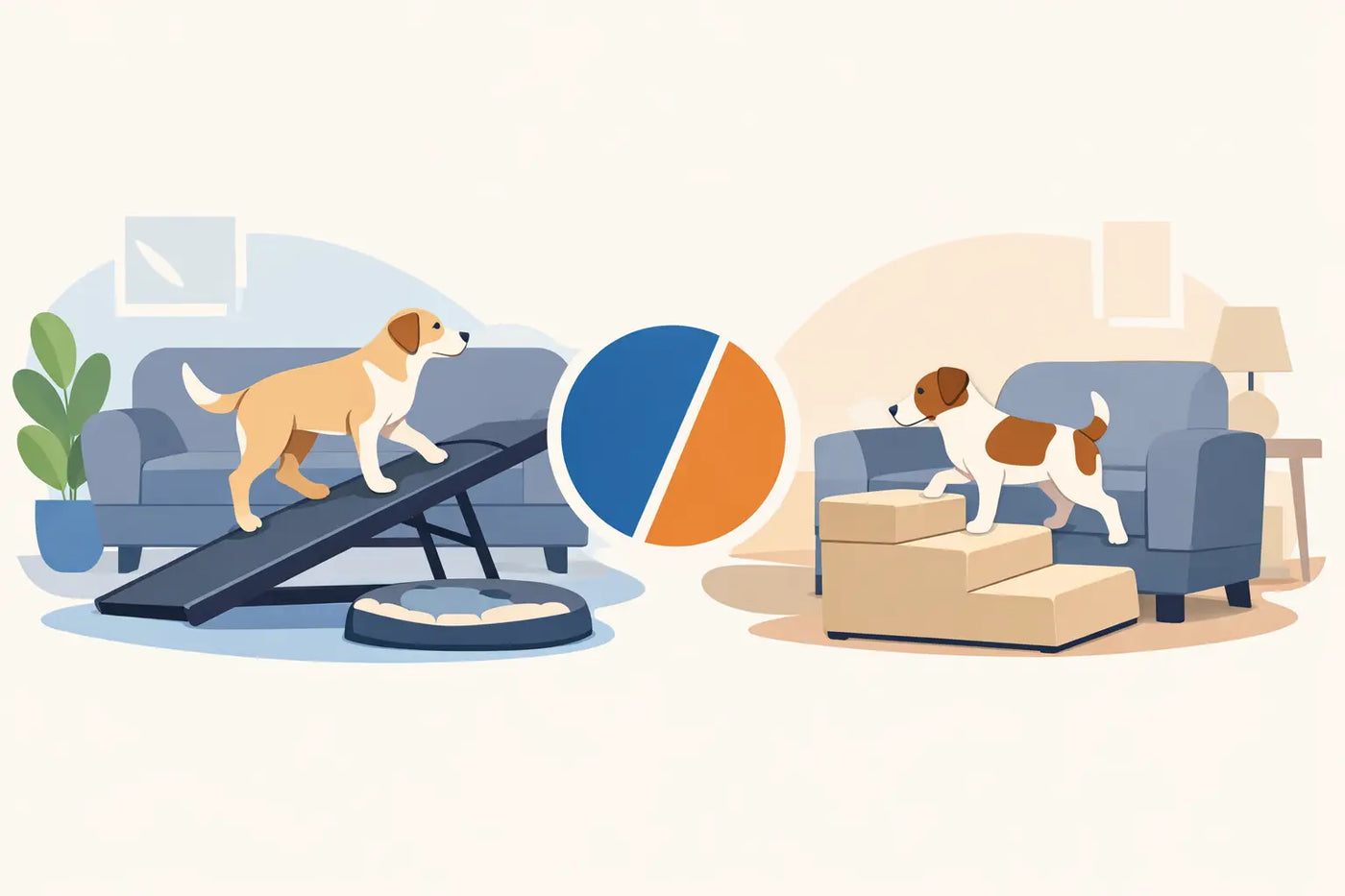
It is often noticeable in a small moment. The dog hesitates at the edge of the sofa, jumps up but lands stiffly, or stops in front of the car and waits for help. When you start comparing dog ramps versus stairs, it is rarely just about convenience. It is about how everyday life feels for the dog, and how long you can make it simple, safe, and gentle.
For many dog families, there is no obvious right answer. A ramp can be kinder to the body, while stairs might feel more natural for some dogs to use. The choice depends on age, size, confidence, the home you live in, and where help is actually needed - by the bed, in the car, on the deck, or in the campervan before the next outing.
Dog ramp versus stairs for different dogs
If your dog is a puppy, a senior, long-backed, or recovering from an injury, the question becomes extra important. Small dogs that often jump up and down from furniture put more strain on their joints than one might think. For large dogs, every change in height becomes a greater physical force. And for breeds with long backs, such as dachshunds or corgis, repeated jumping and awkward landings are something you want to reduce as much as possible.
A ramp provides a smooth path up and down. This means fewer impacts upon landing and less demand for the dog to lift its body step by step. Therefore, a ramp often feels like a gentler choice for dogs with osteoarthritis, joint stiffness, hip problems, or back sensitivity.
Stairs, on the other hand, can work well for dogs that are still energetic, stable, and confident in their movement. A small dog with good balance may sometimes prefer stairs over an incline that feels unfamiliar. It is all about how the dog moves, not just about what looks practical to us.
When a ramp is the better choice
There are situations where a ramp almost always feels like the most thoughtful option. If the dog hesitates before jumping, slips easily, or shows stiffness after resting, a ramp is often easier on the body. The same applies if you want to help the dog into the car without having to lift it every time.
A good ramp is particularly suitable when the height is relatively high. Cars, SUVs, beds, and certain patios can become too high for stairs to feel truly stable, especially for older dogs. The ramp then creates a more natural flow, where the dog walks instead of climbing.
There is also an everyday advantage for you. If you have a larger dog, it is not always sustainable to lift it several times a day. A ramp can relieve both the dog's joints and your own back. For many, it becomes the difference between a solution used occasionally and one that actually works every day.
A ramp is often best for:
- senior dogs
- dogs with osteoarthritis or stiffness
- small dogs that frequently use the sofa or bed
- large dogs that are heavy to lift
- breeds with sensitive backs
- dogs that get in and out of the car often
When stairs can be smarter
Stairs are not wrong just because a ramp often sounds gentler. For some dogs, stairs are easier to understand immediately. A dog that dislikes inclines or becomes unsure on long surfaces might feel more secure with clear steps. This applies especially if the stairs are wide, low, and have good grip.
In smaller homes, stairs can also be more practical. They often take up less space than a ramp with a comfortable incline. If you need something by the bed or sofa and the space is limited, a stable set of stairs may be easier to live with.
Stairs work best when the height is quite low and the dog has sufficient strength to go up and down without stress. But there is an important nuance here: even if the dog can manage stairs, it does not always mean it is the gentlest choice in the long run. Especially going down can be taxing on wrists, shoulders, and the back.
The most important thing is grip and stability
Regardless of whether you choose a ramp or stairs, the surface is crucial. A slippery product helps no dog. If the paws slide, both safety and confidence quickly disappear. Therefore, look at the grip first and the design second.
A ramp should have a non-slip surface and feel sturdy without flexing too much. If it is too steep, it becomes harder to use, especially for small, older, or cautious dogs. A set of stairs should be stable, not wobbly, and have deep enough steps so that the dog can fit its paws properly.
Material also plays a role in everyday life. Soft textile surfaces can feel pleasant indoors, while more durable and easy-to-clean materials are often better suited for the car or outdoors. If the product needs to come along on trips, you also want it to be easy to fold and carry.
How to know what your dog will actually use
The best solution is not always the one that looks best at home. It is the one the dog uses without stress. Many buy first and then hope the dog will get used to it, but a little thought saves both money and frustration.
Start by looking at the dog's behavior. Does it take a run-up before the sofa? Does it avoid jumping down? Does it wait for help by the car? Does it slow down after long walks or after resting? Small signals often say more than you think.
Then think about the place where help is needed. If it is primarily the car, a portable ramp might be most logical. If it is the bed every night, perhaps an indoor solution with a low height and a soft feel fits better. If the dog is very small and confident with steps, stairs can work excellently, but if it is already cautious, a ramp is often easier on the body.
Questions to ask before you choose
- How high is the surface the dog needs to get to?
- Is the dog young, older, or recovering?
- Does the solution need to be out every day?
- Do you have space for a ramp with a reasonable incline?
- Is the dog brave enough for something new, or does the transition need to be extra simple?
Training makes a big difference
Even the best ramp or set of stairs can be left unused if the introduction feels stressful. Dogs need to understand what is expected, at a calm pace. Lure with treats, praise softly, and let the first attempts be short and positive. The goal is for the dog to feel clever, not pressured.
With a ramp, it is especially common for the dog to hesitate at first. The incline can feel unusual. Then it helps to start flat or at a very low height, so that the dog first learns the surface. Once the confidence is there, the rest often comes easier.
With stairs, the same principle applies. If the steps are a little higher than the dog is used to, or if the material feels slippery, it can become unsure immediately. That is why the first impression is important.
Dog ramp versus stairs in the car, at home, and outdoors
In the car, a ramp often wins on pure function. The height is greater, the angle can become steep, and the dog may need to use the solution after walks, baths, or long days out when the body is already tired. Then, a smooth path up is often the kinder alternative.
At home, the choice is more mixed. By a low sofa, stairs can work fine for a small, agile dog. By a high bed or for an older dog, a ramp often feels gentler. On a patio or wooden deck, it depends a lot on the surface, the weather, and how permanent the solution should be.
For families who enjoy outings, cabins, or road trips, flexibility is extra valuable. A portable ramp can travel between home, car, and vacation accommodation in a way that fixed stairs rarely do. There is a clear lifestyle advantage there, especially if the dog is involved in a lot of activities.
There is nothing cute about waiting too long
Many wait until the dog really can no longer manage jumps or heights. But often, the wear and tear is visible earlier than that. A little stiffness, a little hesitation, a slightly greater need for help. It does not have to be dramatic to be worth taking seriously.
Choosing the right support is a thoughtful way to make everyday life softer. Not only when the dog has become old, but also while it is still active and happy. Small adjustments at home can lead to more comfortable days, more confident movements, and less strain over time.
If you are weighing between a ramp and stairs, think less about what looks smoothest for the room and more about what feels kindest for the dog's body. That usually leads you right.