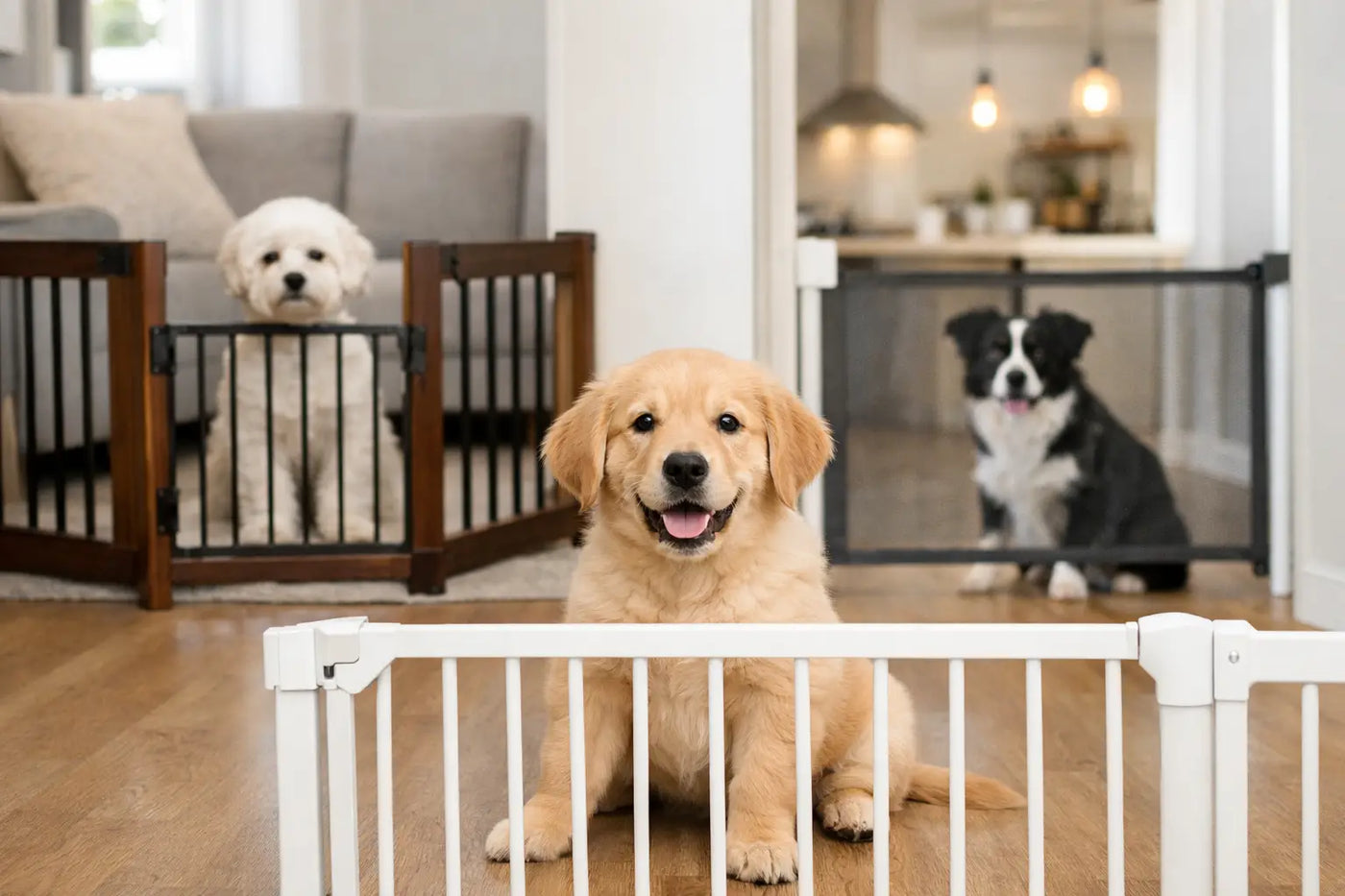
A dog gate can be what makes the morning run smoothly instead of starting with wet paws in the bedroom, a puppy at the stairs, or a dog that loves to "help" when dinner is being cooked. When you are looking for the best dog gates for the home, the choice is therefore about more than just closing off an opening. It is about creating safe zones where both two- and four-legged family members can relax.
The right gate gives the dog clear boundaries without making the home feel enclosed. It can protect small puppies from dangerous stairs, give an older dog a quieter place, or help an eager young dog take breaks when visitors arrive. At the same time, it needs to work for your everyday life - and preferably look like it belongs there.
Start with why you need a dog gate
It is easy to get hung up on color, material, and price, but it is better to start with the situation you want to resolve. Should the gate be placed by a staircase, between the kitchen and the hallway, or around an open-plan layout? Do you need to be able to open it with one hand when carrying grocery bags, or should it just be in place during a limited puppy period?
A gate by a staircase has a clear safety mission. There, stable mounting and the right height are more important than how easy it is to move. A gate between two rooms, on the other hand, can be more flexible, especially if the dog just needs a quiet spot during cooking, cleaning, or when the front door is opened frequently.
Also, consider the dog's personality. A small, calm dog does not need the same type of construction as a strong Labrador with a penchant for leaning against anything that stands in its way. The dog's size, weight, and energy determine how sturdy the gate must be.
The best dog gates for the home suit both room and dog
The best options are rarely exactly the same for every home. A narrow passage in an apartment requires a different solution than a wide doorway in a family home. Always measure the opening in several places before you decide. Walls, baseboards, and uneven surfaces can make a few centimeters more significant than you might first think.
Pressure-mounted gate for flexible openings
A pressure-mounted dog gate is clamped between two stable surfaces without screws. It works well between rooms and in doorways where you want to avoid marks on walls or frames. For many homes, it is the most convenient solution when the gate needs to be movable or removed over time.
The downside is that it is usually not the safest choice at the top of a staircase. Pressure-mounted models often have a low bar at the floor, which can become a tripping hazard when walking by with a laundry basket or with the dog at your heels. They work best where the floor level is even and where the gate is primarily meant to delineate, not to protect against a fall.
Hardware-mounted gate for stairs and strong dogs
A hardware-mounted gate is attached to the wall or frame and is a safer choice for stairs. It sits firmly and reduces the risk of the dog pushing it out of position. Many models have a door that can be opened in one or both directions, which makes everyday life easier when you pass through often.
Here you need to be careful with the mounting surface. Drywall, glass partitions, or unusual stair railings may require special attachments. If you live in a rental, it may be wise to think about how the holes will be handled later, but near a risky staircase, safety should always carry the most weight.
Freestanding gate for open areas
Freestanding dog gates often consist of several panels that can be angled to suit the room. They are great for creating a quiet corner in the living room, blocking off a wide opening, or giving the dog its own area when guests arrive. Some models can even be shaped into a small playpen for the puppy.
This is a more interior-design-friendly solution, especially in wood or subtle, neutral colors. However, a freestanding gate is not right for a dog that likes to jump, climb, or push things with full force. It is best as a clear boundary under supervision, not as a compromise for a strong and inventive dog.
Retractable gate for limited space
Retractable gates often have a mesh or textile strip that is pulled out over an opening and rolled back when not in use. They are practical in narrow hallways or in places where you want to maintain an airy impression. When the gate is open, it takes up almost no space at all.
However, check the height, locking function, and how tight the material is when it is pulled out. A small dog might respect the boundary immediately, while a larger dog might test it with paws and nose. The model needs to suit your dog's specific way of moving and reacting to obstacles.
Materials that work in everyday life
Metal gates are popular because they are durable, easy to wipe down, and often come with practical hinges. They suit many homes but can feel more visible in a room where the decor is important. A model in black, white, or warm gray usually blends in better than shiny metal.
Wooden gates provide a softer and more homey expression. They are especially nice in living rooms and open kitchens where the gate becomes part of the environment. Just make sure the wood is smooth, stable, and treated to withstand damp paws. For dogs that like to chew, metal is often a safer and more long-term choice.
Mesh and textile can be light and discreet, but they are not always right for puppies with sharp teeth or dogs that test boundaries. Choose materials based on how your dog actually behaves, not how you hope it will.
Safety details worth checking
A stylish gate is nice, but a safe gate is invaluable. Check that the height suits the dog - especially if it is athletic or accustomed to jumping up against doors and furniture. The distance between the bars should be small enough so that the head cannot get stuck, but airy enough for the dog to see and feel safe.
The lock should be simple for adults but difficult for dogs and small children to open. Try the mechanism a few times before the gate is put into use. If you need to push hard, lift in a specific way, or use both hands every time, a practical solution can quickly become an annoyance in daily life.
Also look at the floor. Anti-slip pads can protect both the gate and the flooring, while soft protective plates under the mounts can be good for sensitive walls and frames. Regardless of the model, you should check that everything is sitting firmly at regular intervals, especially during the puppy's first curious months.
Make the gate a positive part of the routine
A dog gate works best when it is not perceived as a punishment. Help the dog associate the area behind the gate with something safe: a soft bed, a chew toy, water, and a moment of calm. Start with short periods while you are nearby, and increase the time gradually if the dog is comfortable.
Avoid using the gate only when something "boring" happens, such as when you leave the home or when the dog has done something wrong. Then it can quickly become negatively charged. Instead, the gate can become a natural signal for rest - just like a favorite blanket after a long walk in the woods.
For many dog families, a gate is not a restriction, but a small everyday helper that brings more peace to everyone. Choose the model that suits your home today, but also consider how the dog's needs might change as the puppy grows, routines shift, and life continues out through the door on new adventures.